Denny Zane, the $4 B man
Written by Peter Dreier
July 29, 2026
The unlikely retirement of an exceptional coalition builder
Because I teach at Occidental College, and because Denny Zane went to Oxy, people often assume that I had a big influence on him as a professor and mentor. That is flattering, because Denny has been such an important progressive force in shaping the greater LA area.
But it isn’t true. The truth is that Denny graduated from Oxy in 1969, long before I moved to LA. In fact, he’s older than I am. If anything, he’s been a role model and mentor for me.
Denny is one of the most influential LA political activists that most people have never heard of.
That’s because one of the secrets of Denny’s success is that he doesn’t have to be the center of attention. He doesn’t need to get public credit or see his name in the newspaper. He puts others out front while he typically works behind the scenes, building coalitions and developing strategy.
In the early 1980s, I was living in Boston, teaching at Tufts University, and was active in the tenants’ rights movement. Around that time, I read an article called “How Progressives Won in Santa Monica.” The article focused on a group called Santa Monicans for Renters’ Rights (SMRR), which had been organizing there for several years. They knocked on doors, registered renters to vote, and turned them out in elections. In 1979 they won voter approval of a rent control measure and in 1981 they elected a progressive majority to the Santa Monica City Council and got the city to adopt additional strong tenant protection laws and an affordable housing development program. SMRR helped reshape Santa Monica into a progressive city.
The article mentioned that Denny was one of the founders of SMRR and the manager of the rent control campaign as well as one of the SMRR leaders elected to the City Council. Denny even served as the city’s mayor from 1988 to 1990. Thanks to SMRR, the city’s housing policies protected low-income and elderly renters from big rent increases and evictions. It fostered a nonprofit group to build more affordable housing. It helped design Santa Monica’s new plans to be a more bicycle and pedestrian-friendly city. Denny developed strategies to create the Third Street Promenade and to build mixed-use housing projects in its downtown. SMRR has had its ups and downs, but it has persisted and continues to be a powerful force in Santa Monica, almost 50 years later.
In the early 1980s, when I became Boston Mayor Ray Flynn’s deputy in charge of housing policy, we looked to Santa Monica as a model of progressive planning and housing, in large part because they had empowered tenants, but also persuaded enough homeowners to support the cause of tenants’ rights.
Denny became a master of what we now called the “inside/outside” strategy of politics. He was equally adept as an “outside” agitator organizing protests and building movements to put pressure on government officials and as an “inside” government official, learning the skills and tools needed to formulate and implement policies.
After I moved to LA in 1993, I got to know Denny well. In my early conversations with him, I learned that he grew up in the Inland Empire town of Colton, in a working class family, the son of a steelworker-welder and a licensed vocational nurse.
He was the valedictorian of his class at Colton High School. After graduating from Oxy, he spent 18 years teaching high school history, political science, and math, while he was involved in his civic volunteer work as an activist in Santa Monica.
Then he became a full-time organizer. In that capacity, he’s had a huge impact on housing, transportation and environmental policy in LA and across the state of California.
In the early 1990s, Denny served as the Executive Director of the Coalition for Clean Air, working with state legislators to pass laws to improve the environment and invest state funds in clean alternatives to diesel vehicles. That campaign persuaded the MTA to drop diesel and purchase only cleaner natural gas buses. He also worked with the American Lung Association and NRDC to reduce greenhouse gases in the environment.
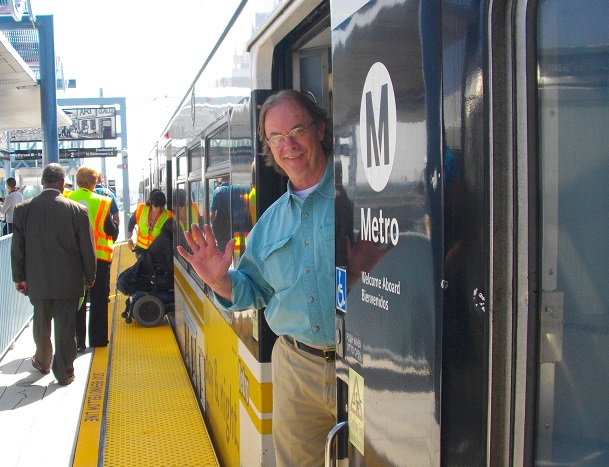
In 2007, inspired by LA Mayor Antonio Villaraigosa’s commitment to the “subway to the sea,” Denny convened labor, environmental and business leaders to create Move LA, an organization initially focused on improving the county’s public transit system. Mayor Villaraigosa led the “inside game” for Measure R at LA Metro and Denny led the “outside game,” organizing the multi-constituency coalition essential for success.
After Eric Garcetti was elected mayor six years later, Denny expanded the coalition and together they convinced Metro that another transit measure victory was possible.
Leading two successful campaigns to persuade voters to increase the LA County sales tax in order to fund a massive expansion of public transit, including more buses and subway lines, in order to get people out of their cars, is a daunting task. But both ballot measures succeeded: Measure R in 2008 and Measure M in 2016. Each received over two-thirds voter support. Together these measures are generating about $2.5 billion a year and will improve the environment and create good jobs in Los Angeles County in perpetuity.
After the Measure M victory, Mayor Garcetti said, “Denny Zane is the grandfather - no, the godfather of Measure R & Measure M.”
Just as Denny did in Santa Monica, Measures R & M are spurring the creation of more “transit-oriented development” – more housing near transportation stops - to get people out of their cars and reduce the need for parking lots.
He’s traveled to cities around the country and around the world to learn the “best practices” for designing better transportation, environmental, and housing policies, and brought those lessons to Los Angeles.
Shortly after Measure M, Zane proposed another ballot measure to Supervisor Mark Ridley-Thomas, who then convinced the County Board of Supervisors to place it on the ballot: a ¼ cent sales tax to raise over $600 million a year to fund services for homeless persons. It was called Measure H. In March 2017, more than two-thirds of LA County voters again voted “yes.”
I worked closely with Denny on his next big idea – to put a measure on the LA City ballot to increase taxes on the sale of all properties that sell for over $5 million in order to raise a lot of money to build affordable housing, provide subsidies to tenants facing eviction, and to also provide tenants with legal advice when they face eviction. The goal was to prevent homelessness and address the city’s severe housing crisis. Denny knew that recent court decisions had made this a majority vote measure if qualified via a signature drive as a voter initiative.
We began talking about this idea in 2019. Denny worked with the hotel workers union, Unite HERE Local 11, to convene an unprecedented coalition of tenants’ groups, labor unions, community organizations, faith-based groups, and nonprofit housing developers – based on his long-standing relationships of trust with these groups.
Denny believed that we could tax very few properties – owned by the richest people – and raise a lot of money for affordable housing. Despite the unified opposition of the real estate and corporate lobby groups, we ran a grassroots campaign that ended when 58% of the voters supported Measure ULA in November 2022. Since then, ULA has raised over $1.2 billion, and the receipts from ULA are going up each month.
During the campaign, the real estate lobby groups lied about the measure. They said it was a property tax. They said it would raise rents. They said it would reduce homeowners’ property values. They said it would destroy LA’s economy and end civilization as we know it.
During the campaign, the ULA coalition held a rally in front of the office of the California Association of Realtors in LA to expose their lies. Denny went to a nearby Burger King and bought a hamburger. I thought it was a bit early for Denny to be eating lunch, but that wasn’t his intention. When it was his turn at the microphone, he held up the hamburger and said that the Realtors and their real estate allies deserved the “Big Whopper” award for their lies and propaganda.
Move LA also played a very significant role in the victory for Measure A, a half-cent sales tax to also fund prevention of homelessness and affordable housing, this time county-wide.
For the past three years, and still today, the real estate industry, the biggest developers, California Business Roundtable, and Jarvis-Gann anti-government fanatics have continued to lie about Measure ULA, in order to weaken or even repeal it. At the end of June, that all came to an end in both Sacramento and in Los Angeles. The coalition of unions, community groups, nonprofit developers, and various allies beat back the efforts to destroy ULA. It will survive intact.
I think we should take inspiration from Denny and give an annual “Big Whopper Award” to the developer, a politician, a so-called researcher, or even a journalist who promotes those lies about a program that helps tens of thousands of people who, thanks to Measure ULA, have good union jobs, have rent subsidies to avoid being eviction, and have friendly attorneys to represent them in court.
Denny has devoted his life, and used his skills, to being a practical idealist, to formulate “big” ideas and develop the skills needed to translate them into realistic policies. He’s built strong coalitions – often among groups that rarely work together – to raise almost $4 Billion per year, revenue streams that will likely last forever to make LA and California more livable.
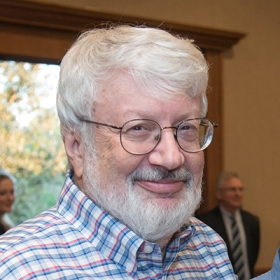
Now 78, on July 4, Independence Day, Denny Zane retired from Move LA.
In the 1970s, a writer named Michael Harrington wrote that people involved in fighting for social justice have to be “long distance runners.” They can’t expect to win important policy and political victories overnight. They need patience and persistence. They have to persevere. When they lose an election or an organizing campaign, they have to pick themselves up, evaluate what happened, and keep going.
Denny never ran for Oxy’s track team, but he is clearly a “long distance runner.” Thus, his closest friends say, he likely won’t be retired for long.