Is California's Public Transit Gaining Momentum...or Hitting the Brakes?

Written by Eli Lipmen
July 23, 2026
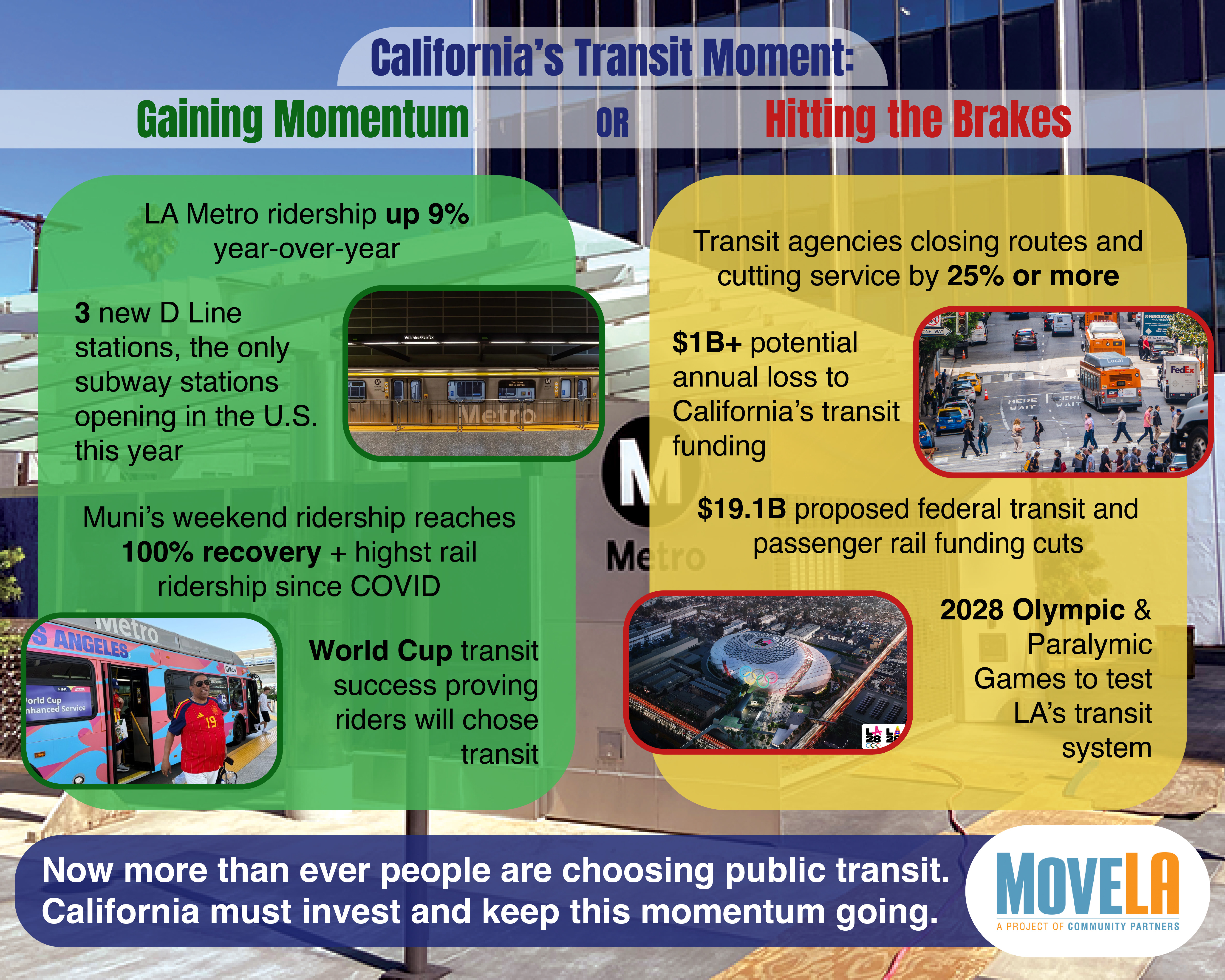
Now more than ever, people are choosing public transit. California must invest and keep this momentum going.
LA Metro’s extension of the D Line to three new stops–now serving the City of Beverly Hills with a subway station–was a bold “OMG Moment” that cracked open the door for Los Angeles to reinvent the way Angelenos move. In a city notorious for its “parking lot” traffic and car-is-king mentality, a once-unfathomable thought has become a reality: traveling from downtown to Beverly Hills is now as quick as 21 minutes thanks to the D.
But Metro’s success lately doesn’t stop there.
June saw a huge 9% jump in ridership: that’s 2.4 million more rides from the 23.8 million we saw this same time last year. Whether they were transit newcomers testing the waters with the D Line as their way to work, or FIFA fans looking to rally at a watch party, the 26.2 million public transit goers this June were met with a fast and reliable automobile alternative.
Metro’s well-executed efforts to connect World Cup fans to stadium seats were one reason for the huge jump. In a reflection on the Games Enhanced Transit Service (GETS), CEO of Los Angeles Metro Stephanie Wiggins explains that the World Cup was a teaching moment, one that will only elevate transit riders’ experience during the 2028 Olympics and beyond.
And, with Metro’s goal of making the 2028 Summer Olympics a “no-car” games, the success of the GETS shows that the vision for a multi-modal region is within reach.
From the D Line extension to the smooth World Cup service, public transit riders across Los Angeles are scoring win after win. These are the signals that Los Angeles is ready for the MOVEment, for the public transit shift.
And it isn’t just limited to Los Angeles–in San Francisco, Muni’s weekend ridership reached 100% recovery and the highest rail ridership since COVID.
The time has come; the momentum is NOW: this is California’s public transit “moment.”
However, I’d be speaking too soon if I said the job is anywhere near done. Amidst these budding successes, public transit in California is showing signs of weakness at the very moment when gas prices have become completely unaffordable, and we need transit now more than ever.
Take the Anaheim Transportation Network (ATN). After nearly three decades of deep commitment to the community, the ATN officially concluded all operations in late March. In the Bay Area, BART is facing a financial deficit and may have to close up to 15 stations or halt service on 25% of its track miles by next year if voters reject a regional funding measure. And in Southern California, Metrolink faces funding, governance, and maintenance challenges that may derail up to 30% of its service.
These “canaries in the coal mine” are a harbinger of a broader industry malaise that is exacerbated by proposed cuts and inconsistent funding support from both the State and Federal governments.
The President’s Fiscal Year 2027 Budget proposes a 23% cut for public transit and an 83% cut in passenger rail. That’s a combined $19.1 billion loss for the transportation sector; 19.1 billion dollars that can’t be used to propel the public transit moment forward.
Changes to how California funds public transit may result in a loss of more than $1 billion in annual funding to transit operations and capital. Our sibling organization, Move California, has launched a campaign to protect critical funding for public transit.
What we are learning is that where there are riders, there is hope. A recent campaign in the Bay Area collected over 300,000 signatures to get the Connect Bay Area Act on the upcoming November ballot. This ballot measure would authorize a fourteen-year sales tax projected to generate over $1 billion annually for Bay Area transit agencies like BART, Muni, and Caltrain. This comes as a saving grace for Bay Area transit after a dip in ridership and revenue post-COVID.
As a campaign fueled by over 1,000 volunteers who collected more than 77,000 signatures, the Connect Bay Area advocacy efforts demonstrate how real change is made by real people coming together to fight against the transit collapse. We need these types of efforts to save public transit.
Transportation continues to be the second highest cost in any household budget. The average US household spends 18% of their income on transportation, with lower-income families needing to allocate over 30% of their income to meet their transportation needs. In California, that means people spend over $13,000 a year just to own a car.
We need thriving bus and rail operations, frequent, safe, and reliable service, protected bike lanes, and pedestrian safety guards–not more lanes.
Public transit should be treated like other public goods, like public parks, public schools, and public pools. With the right investments, enough political will, and public support, transit can become fast, frequent, reliable, affordable, and safe.
But it will only happen when the people mobilize for this change.
While our democratic process fell short on the national level in 2024, it did not disappoint for transit ballot measures. The transportation sector found overwhelming success at the ballot box, with eighteen transportation-related bills passing across the nation. For California, this includes sales and business taxes for transit, and land allocations for bus lanes.
With the 2026 midterm elections on the horizon, it is time to seize the public transit moment. This is why we are rallying in Sacramento on August 10th to fight to keep the moment alive. Join us in the fight to save public transit in California.